Sunday, June 3, 2012
Rhetoric: a political speech that was "a feat of mass hypnosis"
Goebbels' "Total War" speech in Febuary 1943 after Germany's defeat to Soviets at Stalingrad is thought to be a masterly work of political rhetoric. It's also an interesting example of how different audiences heard very different things. Some thought the openness about the serious nature of recent German loses was inspiring because it was honest. Others felt that the call for total war and end of luxury was absurd because standard of living was so low. Others noted its hypnotic effect on the audience.
Here's a translation of he speech: http://bit.ly/KXzmQo
See Richard Evans' The Third Reich at War pp 424-432.

Thursday, May 3, 2012
Curriculum idea: does a liberal arts degree makes sense anymore?
I ask my junior AP Language students to write a synthesis practice paper on this topic, using a series of articles from Writing from Sources. But here are two more articles debating the topic:
Frank Bruni's initial op Ed piece in the NYT (April 29, 2012)
http://www.nytimes.com/2012/04/29/opinion/sunday/bruni-the-imperiled-promise-of-college.html
And a response from Cheryl Greenberg, history professor from Trinity College.
http://www.nytimes.com/2012/05/02/opinion/invitation-to-a-dialogue-a-liberal-arts-degree.html?_r=1
The "Sunday Dialogue" of the NYT is supposed to be about the same topic.
Sent from my iPad
Frank Bruni's initial op Ed piece in the NYT (April 29, 2012)
http://www.nytimes.com/2012/04/29/opinion/sunday/bruni-the-imperiled-promise-of-college.html
And a response from Cheryl Greenberg, history professor from Trinity College.
http://www.nytimes.com/2012/05/02/opinion/invitation-to-a-dialogue-a-liberal-arts-degree.html?_r=1
The "Sunday Dialogue" of the NYT is supposed to be about the same topic.
Sent from my iPad
Thursday, April 26, 2012
"Draft" blog series and David Brooks' "innovation"
A couple more things to check out:
A NY Times-based blog series on the art and craft of
writing. (“Draft features
essays by grammarians, historians, linguists, journalists, novelists and others
on the art of writing — from the comma to the tweet to the novel — and why a
well-crafted sentence matters more than ever in the digital age.”)
Today’s is by John McWhorter, last post by Stanley Fish, Teaser:
The latest word on the
street about English in America – always bad, it seems – is that the shaggy
construction of texting and e-mail spells the death of formal writing. Yet the
truth about English in America – always sunnier, in fact – is that the looseness
and creativity of these new ways of writing are a sign of a new sophistication
in our society. This becomes clear when we understand that in the proper sense,
e-mail and texting are not writing at all.
Second, Tuesday’s David Brooks’ article about “innovation
and the limits of competition”. I’m
planning on using it with the college essay and with Death of a Salesman. Teaser:
One of his
core points is that we tend to confuse capitalism with competition. We tend to
think that whoever competes best comes out ahead. In the race to be more
competitive, we sometimes confuse what is hard with what is valuable. The
intensity of competition becomes a proxy for value.
In fact, Thiel argues, we often shouldn’t seek to be really good
competitors. We should seek to be really good monopolists. Instead of being
slightly better than everybody else in a crowded and established field, it’s
often more valuable to create a new market and totally dominate it. The profit
margins are much bigger, and the value to society is often bigger, too.
Now to be clear: When Thiel is talking about a “monopoly,” he isn’t
talking about the illegal eliminate-your-rivals kind. He’s talking about doing
something so creative that you establish a distinct market, niche and identity.
You’ve established a creative monopoly and everybody has to come to you if they
want that service, at least for a time.
His lecture points to a provocative possibility: that the competitive
spirit capitalism engenders can sometimes inhibit the creativity it requires.
Think about the traits that creative people possess. Creative people
don’t follow the crowds; they seek out the blank spots on the map. Creative
people wander through faraway and forgotten traditions and then integrate
marginal perspectives back to the mainstream. Instead of being fastest around
the tracks everybody knows, creative people move adaptively through
wildernesses nobody knows.
Happy Thursday!
Wednesday, April 25, 2012
A Quartet of Articles
Good morning!
Obviously, yesterday’s PSAE day gave me too much time to get stuff
together to send you:
Remember “Is Making Us Stupid?” published in the Atlantic a
couple years ago? They’ve just published
“Is Facebook Making Us Lonely?” by
Stephen Marche. It’s free online: http://www.theatlantic.com/magazine/archive/2012/05/is-facebook-making-us-lonely/8930/ It’s
not short, but it would be an interesting thing to look at with kids about how
the author spins together narrative and research. The author’s weaving of an macabre
introductory narrative through the essay is pretty cool – it’s about an ex porn
star who dies with her computer on and isn’t found in her apartment for days.
This morning on NPR was a short piece about “Poem in your pocket day” (which is
Thursday, but at HC, according to the signs hung around school, Friday). One cool idea from the program – a high
school teacher from Oklahoma says that he’s having kids write poems in sidewalk
chalk in the courtyard of his school so all kids read them during lunch. http://www.npr.org/2012/04/25/151339990/celebrating-poem-in-your-pocket-day
Sibyl passed the hard copy of NCTE’s policy brief entitled “Evaluating English/Language Arts Teachers”
to me. This reads a good corrective to
all the news about “value added research” that we’ve been reading. If you have only 3 minutes, check out the “Dimensions
of Teacher Quality” on the third page.
Not to brag, but our CPPs have it pretty much right. http://www.ncte.org/library/NCTEFiles/Resources/Journals/CC/0213-mar2012/CC0213Brief.pdf
Heather sent me this USA Today article yesterday about “essay grading machines.” “Study: Machine scoring of essays shows
promise” http://usat.ly/IklU8s Here’s an interesting bit:
Jeff Pence, an English teacher at Dean Rusk Middle School in Canton, Ga., uses computer-aided scoring for his 120-plus students, since hand-grading just one set of writing drafts "with any sense of thoroughness" could take two weeks. The computer takes about three seconds to deliver feedback. So far, each of his students this year has completed more than 25 essays. … He understands the limits of computer grading but says that teachers have limits too. "I know, as does every teacher out there, that on that 63rd essay, I am nowhere near as consistent, accurate or thorough as I was on the first three."
(Here’s another take on these grading machines (which is
not a euphemism for “English teacher”) that Jan Bujan sent me. It’s a blog post that’s linked to the
original studies: )
Tuesday, April 3, 2012
How can I help my child to read in high school?
When parents hear a teacher's recommendation to "read with your child at home" or "help your child with her homework," they are likely to understand those processes in ways that are different than what the teacher intended. Parents often feel unprepared or inadequate to help their children with higher-level homework with reading and writing (Epstein, 2010). The Northern Illinois University Literacy Clinic has produced a Raising Readers series, which includes handouts and videos to help parents understand simple, effective ways they can support their children as readers and writers. The resources cover topics like promoting a love of reading, strategies to support comprehension, comprehension of fiction texts, reading vocabulary, what is fluency?
These handouts are available here: http://www.cedu.niu.edu/ltcy/literacyclinic/raisingReaders/index.shtml
Videos on the literacy clinci's You Tube channel: http://www.youtube.com/user/TheLiteracyClinic
(adapted from Laurie Elish-Piper's article "Parent Involvement in Reading" in the Illinois Reading Council Journal, Spring 2012)
What Does it Take to Succeed in College?

In Redefining College Readiness, U of Oregon professor David T. Conley, who directs the Center for Educational Policy Research, points to four key components of college success:
- key cognitive strategies. Skills in analysis, interpretation, precision and accuracy, and problem solving and reasoning
- key content knowledge. First and foremost the ability to write well. Also the ability to conduct research and knowledge of the big ideas in each content area.
- Academic behaviors. Study skills, time management, persistence, and the ability to work in groups.
- contextual skills and awareness. Knowledge of how to apply to college, manage financial aid issues, and adjust to college culture.
(adapted from Educational Update, ASCD, March 2012)
Student Engagement
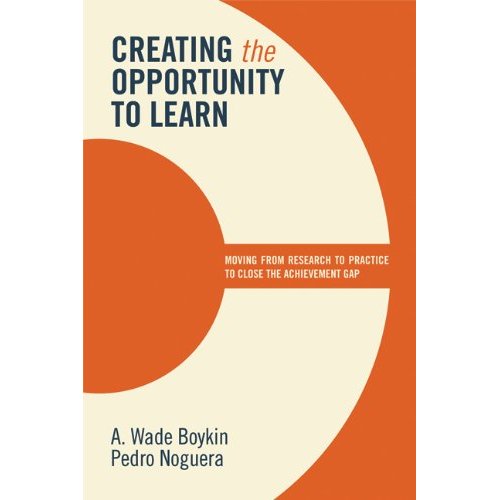
According to Wade Boykin and Pedro Noguera's research review, student engagement was a more significant factor than the amount of instructional time or structural factors, such as student-teacher ratio, in students' achievement in math and reading. These authors say there are three levels of engagement.
- behavioral engagement is "on-task" behavior in class that includes persistence, asking questions, taking part in discussions, and knowing when to ask for help when they are stuck.
- cognitive engagement can be seen when students show deep involvement and effort to understand a challenging concept or issue or acquire a difficult skill
- affective engagement manifests itself through a student's high interest level, positive affect and attitude, curiosity, and task involvement.
(notes from Education Update, ASCD, March 2012)
Subscribe to:
Posts (Atom)