Monday, February 27, 2012

"Top Teachers" in NY's Teacher Data Reports

Teacher rankings are out now in New York. The teachers' union has fought for more than a year to block the release of the ratings, taking the fight to the Supreme Court. All of this comes about because of a state-mandated overhaul of the teacher evaluation system that the state promised Washington in order to qualify for $700 million in federal Race to the Top funds.

At the top, according to the New York Times today, is Walter Galiano, Jr., who, now an assistant principal, is traveling in Italy. Alison Epstein, another teacher at the top of the city's Teacher Data Reports, has been transferred to a gifted class from teaching special education in small class settings. "It's definitely a benefit to have a smaller classroom," she said of her class of 17, "because you can differentiate so much easier."

The rankings come with asterisks and margins or error. (See an example, teacher names and naked statistics here.) But they purport to tell the truth about which teachers are adding value to students and which ones are not. The "top teachers" themselves interpret the results differently. Epstein says that it's largely because of class size that allows her to focus on individual students. Another teacher at the top of the list, Natalie Guandique, who has also left the classroom to finish a master's degree at Columbia, attributes her success to having high expectations for her special-education students. "I came in and said, 'They will learn this,'" Ms. Guandique said. "It may take us a longer time and we may have to take a different path, but they will learn what the other students are learning."

What do these "top teachers" have to teach us? It's a tantalizing question. Is it differentiated instruction? Is it a "can do" attitude? Would a close examination of their classrooms, their attitudes, their assessments, their opening-class routines demonstrate something reproducible? My mind reels at the notion that we could watch the game film of these teachers in action and learn some valuable tricks to spread to other instructors, like that poor teacher with a 2% rating. It could be the case that there's a treasure chest of information there.

I worry: is this search for top teachers a red herring, filled with too many statistical anomalies to be considered useful? Would we learn anything new.... anything, say, that you wouldn't find in Doug Lemov's fine book about instruction, "Teach Like a Champion"? And I worry about the fact that all of the teachers have moved on from their "winning" classrooms. I worry about what that means about the sustainability of this kind of teaching.

I suspect that it could be, as Alison Epstein, one of the "top teachers," says, that the focus on these tests "at times detracts from the overall curriculum." The halo of pressure about the ranking, about student performance on a single test, on out-thinking and out-teaching the test has more detrimental effects than the positive effects of the ranking. "The pressure for teachers and children to perform for tests," Epstein continues, "that do not really show how intelligent a student is, or how amazing a teacher might be, is substantial."

If the goal is to improve instruction for all teachers, this seems like a bizzarre, Byzantine way to do it.

Sunday, February 26, 2012

Well Said

Part of being an educational leader is having the right words at hand. That’s never been an easy thing for me. I try to go overboard with thank you notes and happy birthday emails. Sometimes I come across things that I want to remember, small “well saids.” Here are two recently. The first is from Carol Jago, who had just finished – a couple hours previously – giving a talk to the Metro English Chair group of about 110 people. The second is from Sue L of the MEC steering committee, in response to Carol.


From: Carol J
Sent: Friday, February 24, 2012 5:09 PM
To: David Lange; L, Susan
Subject: Thanks for a great day

I really appreciate the invitation to be a part of your professional community. What a wonderful group of teachers you have gathered together!

Hi Carol.

We are the ones to thank you! As always, you brought energetic conversation that lasted long after the event ended! Thank you for bringing important ideas right to the forefront!

You truly are a teacher at heart, and that comes through every time we are together.

Sue

Tim Ferriss' Tim Method to Convert the Nonfictionist to Fiction

Tim Ferriss is most famous for promoting… Tim Ferriss (great blog name:  Experiments in Lifestyle Design) with books like “The 4-Hour Workweek” and “The 4-Hour Body”.  He weighs in here with his list of novels that nonfiction lovers would love.  I’d add E.L. Doctorow’s “The March” and Cormac McCarthy’s “The Road,“ both of which were devoured by hard-core nonfictionist social studies guys at school.


Reminds me of Jon Scieska’s Guys Read program (a web-based literacy program for boys.  Our mission is to help boys become self-motivated, lifelong readers.).  Website here.  Check it out for books for


Here’s Ferriss’ list.


I’m currently reading:  The Wind-Up Bird Chronicle: A Novel  by Haruki Murakami


Saturday, February 25, 2012

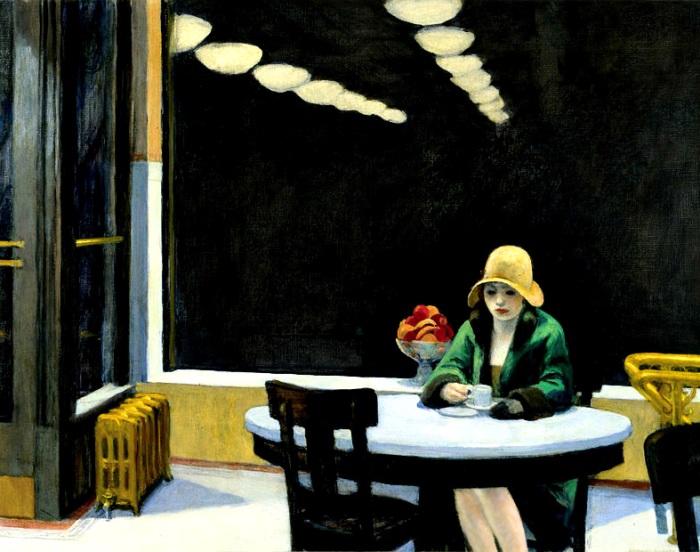
Edward Hopper "Automat"

At Friday's talk, Carol projected this picture, then asked audience members to talk to each other about what we saw in the painting. Don't interpret, just say what you see. One of the goals was to show how much more you could interpret while talking to someone else.

Next, she read us Emily Dickinson's "We Grow Accustomed to the Dark," then asked us to reread it and talk to each other about what we saw. Again, it seems that what we saw together, in pairs, far exceeded what we saw individually. We didn't have time to compare this poem to Frost's Aquainted With the Night, but that was next in the packet.

We grow accustomed to the Dark --
When light is put away --
As when the Neighbor holds the Lamp
To witness her Goodbye --

A Moment -- We uncertain step
For newness of the night --
Then -- fit our Vision to the Dark --
And meet the Road -- erect --

And so of larger -- Darkness --
Those Evenings of the Brain --
When not a Moon disclose a sign --
Or Star -- come out -- within --

The Bravest -- grope a little --
And sometimes hit a Tree
Directly in the Forehead --
But as they learn to see --

Either the Darkness alters --
Or something in the sight
Adjusts itself to Midnight --
And Life steps almost straight.


Friday, February 24, 2012

Four Books that Carol Jago recommended at today's Metro English Chair Luncheon

1. Gold Boy, Emerald Girl, Yiyun Li.
2. The Tiger's Wife, Tea Obreht
3. War Horse, Michael Morpurgo
4. The Warmth of Other Suns, Isabel Wilkerson

Thursday, February 23, 2012

Shaming Teachers into Excellence?

Bill Gates writes an op-ed column today in the NY Times (here) which responds to the recent Supreme Court ruling that paves the way for the publication of teacher ranking lists.

Among many other sensible things, he says:
At Microsoft, we created a rigorous personnel system, but we would never have thought about using employee evaluations to embarrass people, much less publish them in a newspaper. A good personnel system encourages employees and managers to work together to set clear, achievable goals. Annual reviews are a diagnostic tool to help employees reflect on their performance, get honest feedback and create a plan for improvement. Many other businesses and public sector employers embrace this approach, and that’s where the focus should be in education: school leaders and teachers working together to get better.

Wednesday, February 22, 2012

The Paper Grading Load

As a classroom teacher, I always loved planning and instructing. I have never loved grading papers. I'm always on the lookout for good advice for being more efficient and effective at grading papers. So, I was really glad to come across this recent presentation by Carol Jago that is based on her popular book Papers, Papers, Papers. Here's a link to the powerpoint presentation, which includes two really useful things: a list of specific and compelling hints of do's and don'ts. Also, there are examples of what to write on four specific TYPES of student responses -- doesn't answer question, lack of development, etc. Good food for thought.

Tuesday, February 21, 2012

What is Literature Good For?

Carol Jago, in her recent book With Rigor For All (Heineman), cites six contributions that the study of literature makes to student development:

1. intellectual curiosity as the content of great works of literature offers them teh ways and means of delving into stories, and through these stories, of having a vicarious experience of the human condition far greater than any of them could ever acquire on the basis of luck and firsthand encounters
2. cognitive skills through the study of literature that supports the critical reading of all texts, the precise use of language, and the creation of sound arguments
3. aesthetic sensitivity that helps them recognize and respond to art
4. an intra- and intercultural awareness by reading texts from both their own and other cultures
5. an ethical sensitivity that includes the ability to regulate conduct according to principles and the ability to deliberate about issues both in their own heads and in dialogue with others
6. an existential maturity that allows them to behave as civilized human beings in a world where others are not always so inclined.

Jago draws this list from Shaped by Stories: The Ethical Power of Narratives by Marshall Gregory (2009). According to Gregory, existential maturity “is more easily defined by what it is not than by what it is. It is not self-centeredness; it is not unkindness; it is not pettiness; it is not petulance; it is not callousness to the suffering of others; it is not back-biting or violent competitiveness; it is not mean-spiritedness; it is not dogmatism or fanaticism; it is not a lack of self-control; it is not the inability ever to be detached or ironic; it is not the refusal to engage in give-and-take learning from others; it is not the assumption that what we personally desire and value is what everyone else desires and values” (57)

Monday, February 20, 2012

Modeling instruction after what good readers do naturally

What I really love about this section from Carol Jago's With Rigor for All (pp. 111-112) is both the reminder to tell weaker readers the "secret" (or secrets!) of excellent readers AND the paragraph which follows the list, which reminds us that the core of all these strategies is "the thinking that these tools represent."

In order both to help students comprehend demanding literature and to meet Common Core Standards, I begin with the behaviors of good readers behaviors of good readers According to research by Michael Pressley and Peter Afflerback (1995), excellent readers are extremely strategic readers. Often without realizing that they are doing it, strong readers:
  • overview a text before reading
  • determine what is most important in what they are reading
  • use prior knowledge to make sense of new learning
  • predict what is likely to come next in a text
  • construct an interpretation of a text as they read
  • draw inferences from what they read
  • determine the meaning of words they don’t understand, especially when the word seems critical to making sense of the text
  • use techniques such as underlining, rereading, note-taking, visualizing, summarizing, paraphrasing, and questioning strategically to focus their reading
  • engage in an imaginary conversation with the author
  • anticipate or plan for the use of knowledge gained from the reading

Although many remedial reading programs have turned these behaviors into reading strategies, each with its own catchy acronym, I don’t think this is the best method for helping reluctant readers develop the habit of doing these things naturally. Too often the strategies insert a layer of artificiality onto the act of reading. Do you keep a reading log? When was the last time you filled in a wish-bone/fishbone graphic organizer to explain relationships between characters? This is not to say that such tools can’t be helpful for making what is transparent for good readers visible to all students. But too many students think their work is done once they complete the graphic organizer. It’s the thinking that these tools represent, the habits of mind, that we want students ot acquire. Teachers need to be strategic in their use of classroom time so that students spend a brief amount of time practicing strategies and the bulk of their time reading."