Showing posts with label Carol Jago. Show all posts

Thursday, March 1, 2012

What's Going to Be on the New Common Core Test??

I had the opportunity to chat with Carol Jago, past NCTE president and PARCC and NAEP member, last week over lunch. She’s sitting on the committee that’s currently figuring out what the yearly Common Core test will look like. As far as I can recall -- and I should say that there was a glass of wine or two involved over lunch -- there will be two tests: one at the end of the year (May/June) that will feel like an AP Language multiple-choice passage analysis test with a focus on challenging texts – and the examples she gave really were challenging. This one on computer, probably computer adaptive. Another test earlier in the spring (April) will be an "integrated reading and writing task," a writing test that asks kids to create an argument after reading multiple texts – again, it sounded like the “synthesis question” on the AP Language test. This essay test will likely be graded – at least partially – by computers. Again, she offered some pretty interesting examples that involve a range of text types, even paintings.

As far as I’m concerned all this is good news, a good focus on reading challenging texts, argument, analysis, and synthesis. OK… I’m a little concerned with the computer graded essays! But right now, with a couple pounds of essays to grade this weekend, I'm willing to see what those computers can do to provide feedback about things like focus, development, and organization.

Saturday, February 25, 2012

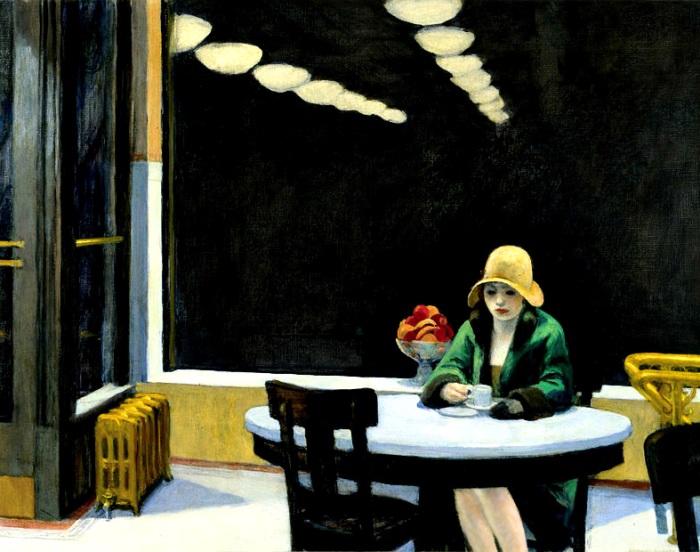
Edward Hopper "Automat"

At Friday's talk, Carol projected this picture, then asked audience members to talk to each other about what we saw in the painting. Don't interpret, just say what you see. One of the goals was to show how much more you could interpret while talking to someone else.

Next, she read us Emily Dickinson's "We Grow Accustomed to the Dark," then asked us to reread it and talk to each other about what we saw. Again, it seems that what we saw together, in pairs, far exceeded what we saw individually. We didn't have time to compare this poem to Frost's Aquainted With the Night, but that was next in the packet.

We grow accustomed to the Dark --
When light is put away --
As when the Neighbor holds the Lamp
To witness her Goodbye --

A Moment -- We uncertain step
For newness of the night --
Then -- fit our Vision to the Dark --
And meet the Road -- erect --

And so of larger -- Darkness --
Those Evenings of the Brain --
When not a Moon disclose a sign --
Or Star -- come out -- within --

The Bravest -- grope a little --
And sometimes hit a Tree
Directly in the Forehead --
But as they learn to see --

Either the Darkness alters --
Or something in the sight
Adjusts itself to Midnight --
And Life steps almost straight.


Friday, February 24, 2012

Four Books that Carol Jago recommended at today's Metro English Chair Luncheon

1. Gold Boy, Emerald Girl, Yiyun Li.
2. The Tiger's Wife, Tea Obreht
3. War Horse, Michael Morpurgo
4. The Warmth of Other Suns, Isabel Wilkerson

Wednesday, February 22, 2012

The Paper Grading Load

As a classroom teacher, I always loved planning and instructing. I have never loved grading papers. I'm always on the lookout for good advice for being more efficient and effective at grading papers. So, I was really glad to come across this recent presentation by Carol Jago that is based on her popular book Papers, Papers, Papers. Here's a link to the powerpoint presentation, which includes two really useful things: a list of specific and compelling hints of do's and don'ts. Also, there are examples of what to write on four specific TYPES of student responses -- doesn't answer question, lack of development, etc. Good food for thought.

Tuesday, February 21, 2012

What is Literature Good For?

Carol Jago, in her recent book With Rigor For All (Heineman), cites six contributions that the study of literature makes to student development:

1. intellectual curiosity as the content of great works of literature offers them teh ways and means of delving into stories, and through these stories, of having a vicarious experience of the human condition far greater than any of them could ever acquire on the basis of luck and firsthand encounters
2. cognitive skills through the study of literature that supports the critical reading of all texts, the precise use of language, and the creation of sound arguments
3. aesthetic sensitivity that helps them recognize and respond to art
4. an intra- and intercultural awareness by reading texts from both their own and other cultures
5. an ethical sensitivity that includes the ability to regulate conduct according to principles and the ability to deliberate about issues both in their own heads and in dialogue with others
6. an existential maturity that allows them to behave as civilized human beings in a world where others are not always so inclined.

Jago draws this list from Shaped by Stories: The Ethical Power of Narratives by Marshall Gregory (2009). According to Gregory, existential maturity “is more easily defined by what it is not than by what it is. It is not self-centeredness; it is not unkindness; it is not pettiness; it is not petulance; it is not callousness to the suffering of others; it is not back-biting or violent competitiveness; it is not mean-spiritedness; it is not dogmatism or fanaticism; it is not a lack of self-control; it is not the inability ever to be detached or ironic; it is not the refusal to engage in give-and-take learning from others; it is not the assumption that what we personally desire and value is what everyone else desires and values” (57)

Monday, February 20, 2012

Modeling instruction after what good readers do naturally

What I really love about this section from Carol Jago's With Rigor for All (pp. 111-112) is both the reminder to tell weaker readers the "secret" (or secrets!) of excellent readers AND the paragraph which follows the list, which reminds us that the core of all these strategies is "the thinking that these tools represent."

In order both to help students comprehend demanding literature and to meet Common Core Standards, I begin with the behaviors of good readers behaviors of good readers According to research by Michael Pressley and Peter Afflerback (1995), excellent readers are extremely strategic readers. Often without realizing that they are doing it, strong readers:
  • overview a text before reading
  • determine what is most important in what they are reading
  • use prior knowledge to make sense of new learning
  • predict what is likely to come next in a text
  • construct an interpretation of a text as they read
  • draw inferences from what they read
  • determine the meaning of words they don’t understand, especially when the word seems critical to making sense of the text
  • use techniques such as underlining, rereading, note-taking, visualizing, summarizing, paraphrasing, and questioning strategically to focus their reading
  • engage in an imaginary conversation with the author
  • anticipate or plan for the use of knowledge gained from the reading

Although many remedial reading programs have turned these behaviors into reading strategies, each with its own catchy acronym, I don’t think this is the best method for helping reluctant readers develop the habit of doing these things naturally. Too often the strategies insert a layer of artificiality onto the act of reading. Do you keep a reading log? When was the last time you filled in a wish-bone/fishbone graphic organizer to explain relationships between characters? This is not to say that such tools can’t be helpful for making what is transparent for good readers visible to all students. But too many students think their work is done once they complete the graphic organizer. It’s the thinking that these tools represent, the habits of mind, that we want students ot acquire. Teachers need to be strategic in their use of classroom time so that students spend a brief amount of time practicing strategies and the bulk of their time reading."